Endpoints#
An endpoint gives a stable name to the workers whose labels match its selector. Clients use the endpoint's name instead of worker addresses, which change every time a worker restarts or moves. Only workers that are ready receive traffic.
Use an endpoint to:
- let other runs reach a service by name: a Redis, a vector database, a model server (
redis.<namespace>.astraeus.local); - put several replicas of a service behind one name;
- publish a service outside the cluster on a fixed port of your ingress machines (see External access);
- let the console or an API client call a service's HTTP API through the cluster, within an allow-list of methods and paths.
A replica group with a load balancer creates and keeps its own endpoint. A run's external_accesses also become endpoints. This page covers endpoints you create yourself.
Headless and balanced#
mode |
Inside the cluster | Outside the cluster |
|---|---|---|
headless (default) |
The name resolves to the addresses of the ready workers. The client picks one and connects to the worker's port. | Not exposed. port is informational. |
balanced |
The same: the name resolves to the ready workers. | A listen port (30000–32767) is reserved for the endpoint, the same on every machine. Envoy on your ingress machines listens on it and balances across the ready workers, and/or each worker's machine publishes it (exposure). |
Inside the cluster, clients always connect to workers directly at target_port. Envoy is only used for traffic from outside.
Before you begin#
- You need the admin or editor role in the workspace.
- The workers you want to select must carry labels. Labels you set on a run (
metadata.labels) are copied to every worker of the run. Every worker also carriesjob.astraeus.io/group,job.astraeus.io/replica-indexandjob.astraeus.io/group-replica-index. - Workers resolve names through the cluster DNS only on the node network (the default network mode). See Names and service discovery.
- For the API examples, set
TOKENandAPIas described in Drives.
No CLI commands for endpoints
The astra CLI has no endpoint commands. Use the console or the API.
Create an endpoint#
The example exposes a run of an HTTP API server listening on port 8080.
-
Label the run. Create it with a label, for example
"metadata": {"name": "api-server", "labels": {"app": "api"}}, and add a health check to its worker template so that only healthy workers receive traffic:run.json (excerpt){ "metadata": {"name": "api-server", "labels": {"app": "api"}}, "spec": { "lifetime": "Service", "task_template": { "image": "ghcr.io/acme/api:3.2", "requested_resources": {"cpu_cores": 2, "memory_bytes": 4294967296}, "health_check": {"type": "HTTP", "path": "/healthz", "port": 8080} } } } -
Create the endpoint.
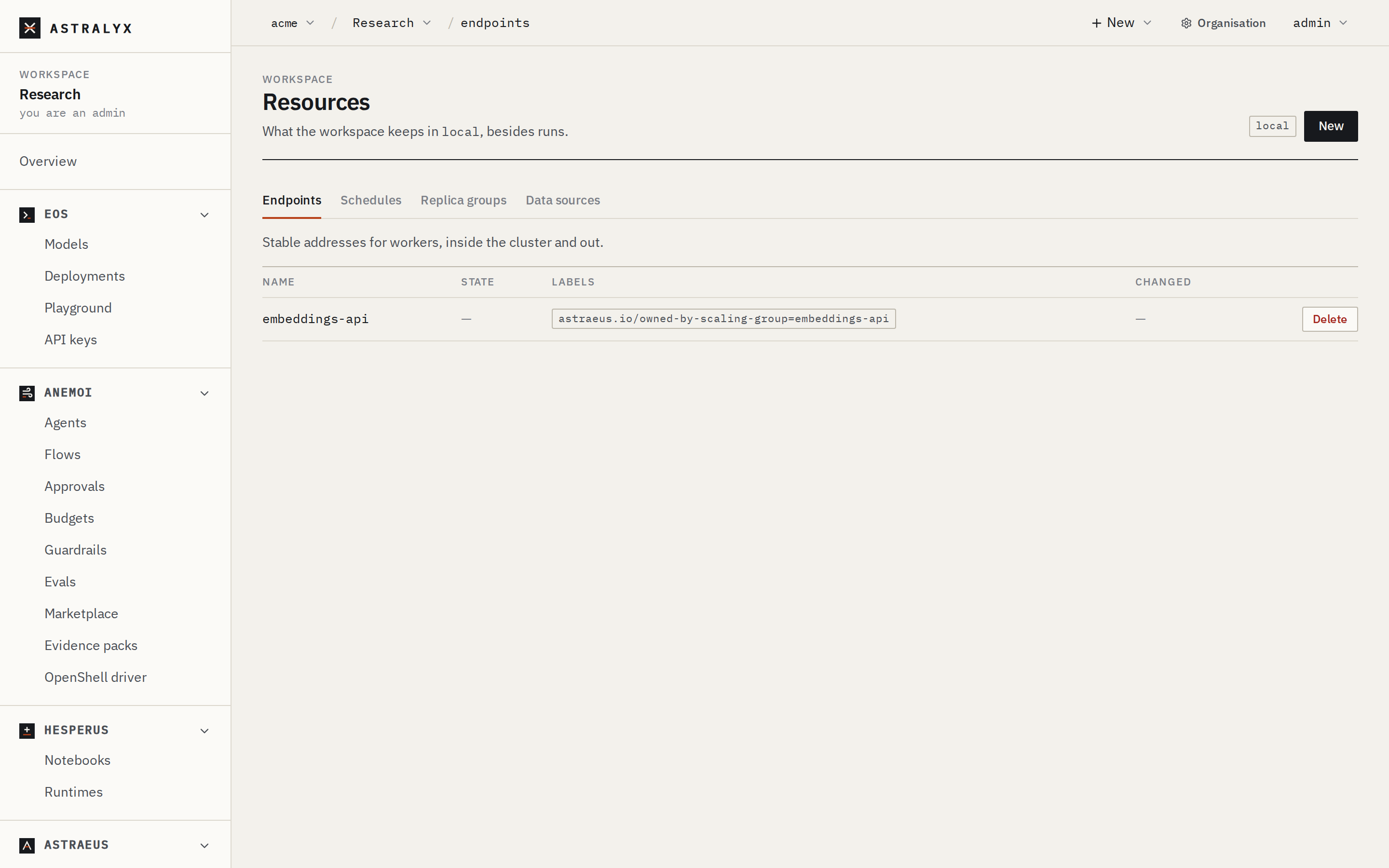
- Open Resources in the workspace, choose the cluster, and select the Endpoints tab.
- Click New. A JSON editor opens with a starting point.
-
Enter the endpoint and click Create:
-
Check its backends.
GET $API/endpoints/apireturns the endpoint with itsruntime:{ "runtime": { "address": "api.ws-3f9c2a7d41be.astraeus.local", "ready_backends": 1, "total_backends": 1, "backends": [{"task_name": "api-server-0", "ip": "10.240.3.7", "ready": true, "state": "Running", "node_name": "gpu-02"}] } }The second part of the address is the workspace's namespace (
ws-and 12 hexadecimal digits). -
From any worker of the same workspace, call it by name at the workers' port:
A balanced endpoint#
Set mode to balanced to reserve a listen port and serve it from your ingress machines:
{
  "metadata": {"name": "api"},
  "spec": {
    "selector": {"app": "api"},
    "mode": "balanced",
    "target_port": 8080,
    "protocol": "http",
    "health_check_path": "/healthz"
  }
}
With port omitted (or 0), the cluster assigns the lowest free port from 30000–32767 and keeps it for the endpoint's life. runtime.listen_port shows it. See External access for how clients outside reach it.
Which workers receive traffic#
A worker is a backend of the endpoint when:
- it is in the same workspace as the endpoint. A selector never reaches another workspace's workers;
- it carries every label of the selector (an empty selector is refused).
A backend is ready, and receives traffic, when:
- the worker is
Running; - it has an address;
- if its worker template has a
health_check, the last check passed.
The cluster updates backends as workers change state. In the cluster DNS, the endpoint's name has an address only while at least one backend is ready.
Health checks#
There are two kinds of check, and a balanced endpoint can use both:
-
The worker's own
health_checkdecides readiness for every endpoint and for the DNS. It runs on the worker's machine:Field Default Description typerequired HTTP(aGETthat must succeed),TCP(a connection) orExec(a command in the container).pathHTTP only: the path. portHTTP and TCP: the port, 1–65535. commandExec only: the command and its arguments. interval_seconds10Seconds between checks. timeout_seconds5Seconds a check may take. Must be less than the interval. failure_threshold3Consecutive failures before the worker is unhealthy. initial_delay_seconds0Seconds before the first check. -
health_check_pathon a balanced endpoint with protocolhttporgrpcadds an active check by Envoy on the ingress machines: every 3 s, 2 s timeout, unhealthy after 2 failures, healthy again after 2 successes.
Envoy also ejects a backend for 10 s after 5 consecutive 5xx answers.
Call a service through the cluster#
An endpoint with a proxy can be called through the cluster's API, as the user making the request. Use it to reach a service from the console or from a machine that is not on the mesh, without publishing a port. Only the methods and paths you allow are relayed:
{
  "metadata": {"name": "api"},
  "spec": {
    "selector": {"app": "api"},
    "target_port": 8080,
    "protocol": "http",
    "proxy": {"enabled": true, "allowed_methods": ["GET", "POST"], "allowed_paths": ["/v1/*"], "timeout_ms": 30000}
  }
}
| Field | Default | Description |
|---|---|---|
enabled |
false |
A disabled proxy allows nothing. |
allowed_methods |
["GET"] |
Any of GET, POST, PUT, PATCH, DELETE, HEAD, OPTIONS. |
allowed_paths |
required when enabled | Patterns starting with /. /v1/* matches /v1 and everything below it. A pattern ending in a bare * (/v1*) is a plain prefix and also matches /v1backdoor: prefer /v1/*. |
max_body_bytes |
1000000 |
Largest request body, at most 1400000. |
timeout_ms |
10000 |
How long the cluster waits for the answer, at most 60000. |
How the relay behaves:
- The path is percent-decoded and
.and..are resolved before it is matched. A path that climbs above/is refused. - Only the request headers
Content-Type,Accept,Accept-EncodingandX-*are forwarded. - Answers are cut at 700 KiB.
- The request goes to one ready backend. When none is ready, the answer is
503 NO_READY_BACKEND(the endpoint has no ready backend). For an endpoint that can wake a replica group, the cluster wakes it and holds the request up to 45 s (see Replica groups). - Refusals:
403 PROXY_DISABLED,403 PROXY_METHOD_NOT_ALLOWED,403 PROXY_PATH_NOT_ALLOWED,400 PROXY_BODY_TOO_LARGE,400 PROXY_BAD_PATH.
Change or delete an endpoint#
On Resources → Endpoints, click a row to see the endpoint as JSON, or Delete to delete it. There is no edit form: use the API to change one.
Replace the spec. The body carries the whole new spec:
$ curl -sS -X PUT "$API/endpoints/api" \
    -H "Authorization: Bearer $TOKEN" -H "Content-Type: application/json" \
    -d '{"spec": {"selector": {"app": "api"}, "mode": "balanced", "target_port": 8080, "protocol": "http"}}'
Delete it:
The cluster answers 204 No Content.
An endpoint that a run's external access created is changed through the run: a direct change is refused with 409 MANAGED_BY_JOB (endpoint web-http is run web's external access; change the run instead). An endpoint that a replica group owns is rewritten by the group on its next pass.
Reference#
| Field | Type | Default | Description |
|---|---|---|---|
metadata.name |
string | required | Letters, digits, - and _, at most 63 characters, not starting or ending with -. It becomes a DNS name. |
spec.selector |
map | required | Labels a worker must all carry. At least one. |
spec.mode |
headless | balanced |
headless |
See Headless and balanced. |
spec.port |
integer | 0 |
Balanced: the listen port, 30000–32767, or 0 to have one assigned. Headless: informational. |
spec.target_port |
integer | port |
The workers' port. Required for a balanced endpoint. |
spec.protocol |
tcp | http | grpc |
tcp |
How Envoy proxies it: TCP, or HTTP (HTTP/1.1 and HTTP/2 from clients; HTTP/2 to grpc backends). |
spec.health_check_path |
string | none | Balanced, http or grpc: Envoy's active check path. Starts with /. |
spec.route_timeout_seconds |
integer | none (unbounded) | Balanced, http or grpc: the most a whole response may take. |
spec.stream_idle_timeout_seconds |
integer | 3600 |
Balanced, http or grpc: the longest gap between bytes. |
spec.exposure |
ingress | nodeport | both |
ingress |
Balanced only: where the listen port opens. See External access. |
spec.proxy |
object | none | The HTTP allow-list for calls through the cluster. See Call a service through the cluster. |
spec.wake_targets |
list | none | Replica groups to wake when a request finds no ready backend. Set by replica groups for their own endpoints. |
Runtime#
| Field | Description |
|---|---|
address |
<name>.<namespace>.astraeus.local. |
ready_backends, total_backends |
Ready and selected workers. |
backends |
Each worker: task_name, ip, ready, state, node_name. |
listen_port |
Balanced: the reserved port, the same on every machine. |
Errors#
| Code | When |
|---|---|
400 INVALID_ENDPOINT |
An invalid spec, such as spec.selector must name at least one label or a balanced endpoint needs spec.target_port (or spec.port). |
400 NAME_NOT_DNS_SAFE |
The name cannot be published in DNS. |
409 PORT_TAKEN |
port 30080 is reserved by endpoint web. |
409 PORTS_EXHAUSTED |
All 2,768 ports of 30000–32767 are reserved. |
409 ENDPOINT_ALREADY_EXISTS |
The name is taken. |