The marketplace#
The marketplace is where agents and flows are shared inside your organisation. It has two parts: the built-in starters Astralyx ships, and the templates your workspaces publish for each other. This page explains what a template is and what installing one does.
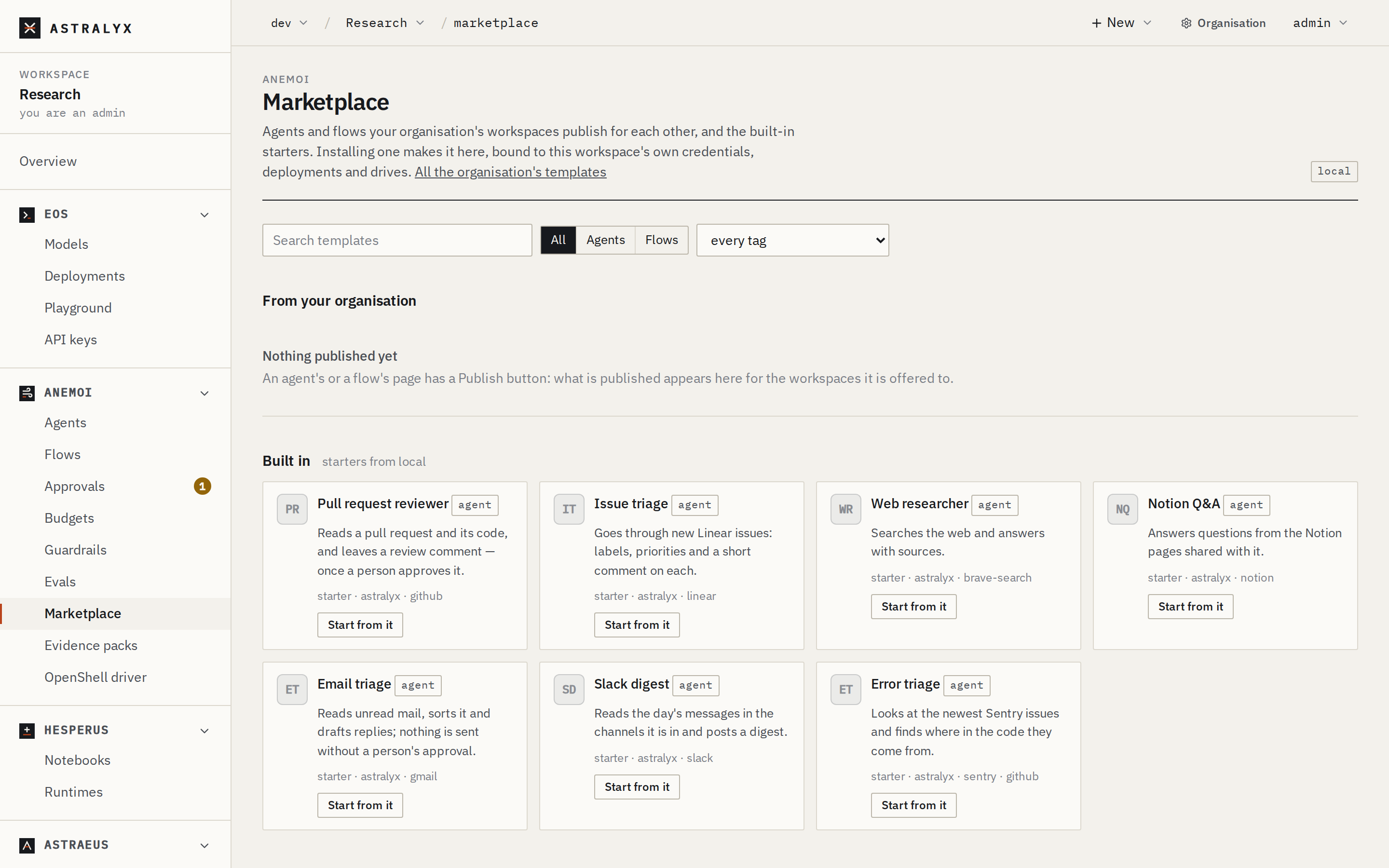
Built-in starters#
Ready agents to adjust, each with its instructions, connection, access level and sandbox:
| Starter | What it does | Connection |
|---|---|---|
| Pull request reviewer | Reads a pull request and its code, and leaves a review comment — once a person approves it. | GitHub, writes need approval |
| Issue triage | Goes through new Linear issues: labels, priorities and a short comment on each. | Linear |
| Web researcher | Searches the web and answers with sources. | Brave Search |
| Notion Q&A | Answers questions from the Notion pages shared with it. | Notion |
| Email triage | Reads unread mail, sorts it and drafts replies; nothing is sent without a person's approval. | Gmail |
| Slack digest | Reads the day's messages in the channels it is in and posts a digest. | Slack |
| Error triage | Looks at the newest Sentry issues and finds where in the code they come from. | Sentry, GitHub |
Start from it opens New agent filled in; you pick the model and the credentials.
Templates#
A template is a snapshot of one version of an agent's or a flow's specification, published from a workspace. What it references — credentials, deployments, agents, flows, drives — is listed by name as its requirements, never their values; a publication that looks like it holds a secret is refused.
- Publishing (workspace editors, Publish on an agent's or flow's page) makes a new template or a new version of one, offered to the whole organisation or to named workspaces.
- Installing (workspace editors) binds every requirement to a name of your workspace — your own GitHub credential, your own deployment — and makes the agent or flow there, through the same checks as making it by hand. Installing again with Update writes the template's newer version as a new version of the installed agent or flow; the marketplace says when an update is available.
- Approval: an organisation can require that versions published by someone other than an admin wait for an admin's approval. Approving, rejecting and withdrawing versions are covered in Agent governance.
Templates are kept by the console (at most 256 KiB of specification each), outside any cluster; what a run made is never in one.